Mention the word prospecting and my mind goes straight to gold diggers. In the commercial world, the word is enough to send shivers down many professional’s spine. This word is inextricably associated with hit and miss. Dig a hole and see if you’re lucky; make some cold-calls and see if anything comes from it. This is not the way to do business effectively (nor is it a good way to find gold!). So we are going to banish it from our vocabulary..done! But what can we replace it with?
If we have people “developing business”, it goes without saying that the business/opportunity in question has already been identified. I suggest we call it exactly that “Opportunity identification”. Some people will say this is the same as a lead, however once again, following up a lead infers you will try your luck and see what happens. We really want to have more control than that.
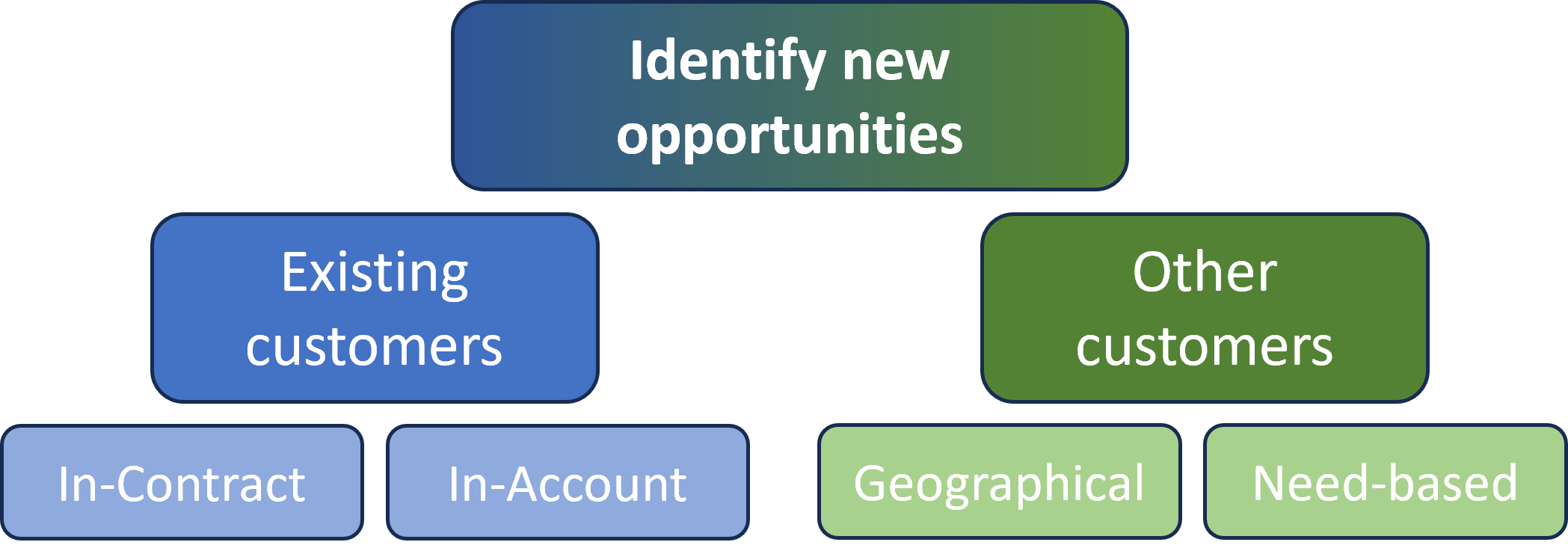
The analytic inside me will ask ”where are the sources of these opportunities?”. In business this will be either from customers with whom we already have a working relationship, and those that we don’t; and of course identifying potential opportunities is quite different between the two.
If you already have a relationship and hopefully a positive reputation, you can look to your existing contract(s) for additional work. These “In-contract opportunities” will always be the quickest time to cash for you. Beyond existing contracts you can look at similar scenarios or challenges this customer has in other business units. You can leverage your track record and contacts to help develop these. We will call these ”In-account opportunities”.
Bear in mind that we are talking about identifying opportunities not developing them. It goes without saying that this does not have to be the responsibility of Business Development or Sales teams. In fact, given the right guidance this is much better accomplished by operations teams who have closer contact with their customers and are far better placed to identify these forms of opportunities.
The second group effectively represents the rest of the world!. A big place and so few people to address it! Here we need to apply some sensible segmentation and there are again two obvious ones. Geographical and needs-based. If we segment geographically we have a couple of options; provide similar services to other customers in the same geographical location, or in other areas that resemble your existing base. The second way to segment is to evaluate the customer needs you are addressing today and look for other customers with similar needs.
Such segmentation does not need to be a massive operation, but more importantly when we take this more structured approach we can link it to the volume of new opportunities we actually need to deliver our growth. When you strip away foolish volume-based incentive schemes it will always be better to have a smaller number of opportunities that have a reasonable chance of being converted into business, than the scatter-gun approach associated with the word “prospecting”. Its always better to prosper rather than prospect.